
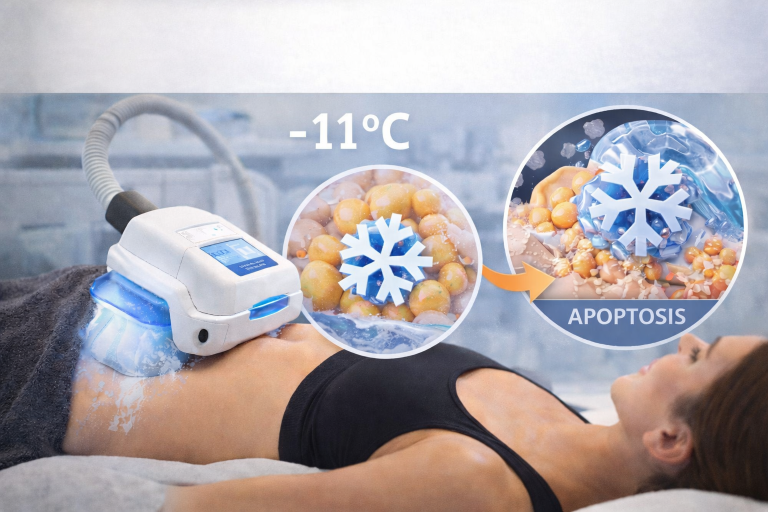
Cryolipolysis is a non-surgical fat reduction technique that uses controlled cooling to selectively damage and eliminate fat cells (adipocytes) beneath the skin, while aiming to spare the skin and surrounding tissues.
What it means in plain language
- “Cryo” = cold
- “Lipo” = fat
- “Lysis” = breakdown/destruction
Thus, cryolipolysis equals “fat cell destruction using cold.”
What happens after treatment (high level)
- The cooled fat cells are injured, then your body gradually clears them out through natural processes over the following weeks to months.
- It’s meant for eliminating localized fat pockets, not overall weight loss.
The science behind cryolipolysis is well-documented and clinically validated. The FDA cleared the first cryolipolysis device in 2010, and over 17 million treatments have been performed globally using this mechanism. Understanding how scientific fat freezing works at the biological level, why it targets fat, why it spares other tissue, and why results take several weeks to appear is the foundation for evaluating whether the procedure is appropriate for you. For a complete look at the safety data behind this science, read Is CoolSculpting Safe? Medical Risks & FDA Clearance.
How Cryolipolysis Works at the Cellular Level
Cryolipolysis is a biological technique that operates with a controlled sequence: cooling, crystallization, membrane disruption, and apoptosis.
A vacuum applicator draws the targeted tissue between two cooling panels. The panels lower the tissue temperature to approximately -11°C, a precise threshold calibrated to affect fat cells while leaving other structures undamaged. At this temperature, the lipids within fat cells undergo a phase transition from liquid to solid. The fat cells crystallize.
These crystalline structures are not smooth. They form jagged lattices that pierce the fat cell membrane, the phospholipid bilayer, from the inside out. This internal membrane disruption triggers apoptosis: programmed cell death. The cell doesn’t rupture violently. It initiates a controlled self-destruction sequence that signals the body’s immune system to begin clearance.
The result is selective fat cell death in the treated area. The cells that undergo apoptosis are processed by macrophages and cleared through the lymphatic system over the following weeks. This biological clearance pathway is why cryolipolysis results are gradual rather than immediate; the body needs time to metabolize and discharge what the treatment has eliminated.
Why Fat Freezes Before Everything Else: Cyrolipolysis Discovery
The selectivity of cryolipolysis depends on a fundamental physical discovery: lipids crystallize at a higher temperature than water.
Fat cells are lipid-dense. Skin, muscle, and nerve tissue are water-based. When tissue is cooled to -11°C, the lipid-rich fat cells reach their crystallization point while the water-based cells in surrounding structures remain in a liquid state and functionally unaffected. This differential freezing threshold is the entire basis of the cryolipolysis mechanism’s safety profile.
The American Society for Dermatologic Surgery classifies cryolipolysis as an established non-surgical fat reduction approach, and this thermal selectivity is cited as the core safety mechanism across clinical literature. The cooling temperature is not arbitrary; it is the precise point where fat is vulnerable, and everything else is protected.
There is also a secondary mechanism that supports selectivity: the vacuum itself. The applicator’s suction draws tissue between the cooling panels, which restricts blood flow to the targeted pocket. This ischemic response concentrates the cold in the adipose layer, preventing warm circulating blood from dissipating the thermal effect before crystallization occurs.
Apoptosis vs Necrosis: Why the Distinction Matters
Not all cell death is equal. Cryolipolysis triggers apoptosis, and that distinction defines why the procedure is safe and why results develop gradually.
Apoptosis is programmed cell death. The cell initiates a structured shutdown: it shrinks, its DNA fragments in a controlled fashion, and it sends signaling molecules that attract macrophages for clean removal. There is no inflammatory cascade. No scarring. No collateral tissue damage. The body treats apoptotic cells as normal biological waste and processes them through existing metabolic pathways to discard them.
Necrosis is traumatic cell death. When cells rupture from uncontrolled damage, heat burns, chemical exposure, or mechanical injury, the contents spill into the surrounding tissue. This triggers inflammation, immune response, and potential scarring. Necrosis is what can happen when a fat reduction method lacks precision.
The cryolipolysis mechanism specifically avoids necrosis. The controlled temperature maintains fat cells at the crystallization threshold without the kind of extreme thermal damage that would cause violent rupture. This is why common side effects of cryolipolysis, such as temporary numbness, redness, and mild swelling, are localized and self-resolving rather than systemic. For the full side effect profile, including rare complications, see Does CoolSculpting Really Work? Clinical Outcomes.
What Happens After Treatment: Cryolipolysis Timeline
Understanding what happens after fat cell apoptosis explains why cryolipolysis results take multiple weeks, not days, to become visible.
Once fat cells undergo apoptosis, the body’s immune system begins a slow clearance. Macrophages engulf the dead cells and transport the lipid contents into the lymphatic system for metabolic processing. The liver processes the released lipids, and they are eliminated through normal metabolic pathways. This clearance process has finite throughput; the lymphatic system can only process a certain volume of cellular debris at a given rate.
The clinical timeline reflects this biology:
Weeks 1–3: The apoptotic process is underway but not yet visible. Fat cells are dying and being flagged for clearance.
Weeks 3–4: Initial changes become noticeable as the first wave of fat cell clearance completes.
Weeks 6–8: Visible contouring develops as clearance continues.
Weeks 8–12: Peak results emerge. The majority of treated fat cells have been metabolized and cleared.
This gradual progression is a feature of the cryolipolysis mechanism, not a limitation. It reflects the difference between apoptotic clearance (clean, gradual, safe) and necrotic destruction (fast, inflammatory, damaging). CoolSculpting.com documents this same timeline in its patient education materials, and clinical trial endpoints are measured at the 8-12 week mark for this reason.
From Science to Application: What This Means for You
Cryolipolysis is the mechanism. CoolSculpting Elite is the FDA-cleared device that applies it. The relationship is comparable to laser technology and a specific laser device –one is the science, the other is the clinical tool.
Understanding the science matters because it reveals what the procedure can and cannot do. Cryolipolysis treats subcutaneous fat, the pinchable layer under the skin. It does not treat visceral fat, does not necessarily produce weight loss, and does not tighten skin. It produces a measurable, verifiable reduction in fat volume in a specific area: 20–25% per treatment cycle, confirmed through ultrasound measurement.
At Sculptology, the cryolipolysis mechanism represents Phase 2 of The S-Method™, a physician-supervised process designed to maximize treatment precision and outcomes. The protocol begins with candidacy screening through the Bio-Mechanical Survey, followed by detailed treatment planning using precision mapping on a 2 cm × 2 cm anatomical grid, and continues with structured follow-up using S-Index tracking at 4, 8, and 12 weeks. While the science behind cryolipolysis is well established, outcomes depend on the clinical framework that surrounds it. The approach at Sculptology demonstrates how the biological mechanism of fat freezing can be translated into a carefully managed clinical pathway that supports consistent, measurable results.
| UNIQUE SCULPTOLOGY INSIGHT The Mechanism Is Only as Good as the Process Around It Most patients who research cryolipolysis are doing the right thing, understanding the science before committing to the procedure. The problem is that science alone doesn’t determine the outcome. The same mechanism applied with different candidacy screening, a different mapping approach, and different post-treatment protocols produces different results, which means knowing how cryolipolysis works is necessary but not sufficient. At Sculptology, the short post-treatment mechanical massage that disrupts the crystalline lattice increases treatment efficacy by up to 68%. That’s not just a detail in a research paper; it’s the difference between a good result and a great one. The mechanism is the foundation. The process before, during, and after is what determines whether the foundation delivers fully and is impactful. |
Frequently Asked Questions About Cryolipolysis
What does cryolipolysis mean?
Cryolipolysis literally means “cold fat destruction.” It is a non-surgical fat reduction method that uses controlled cooling to trigger apoptosis, programmed cell death, in subcutaneous fat cells. The treated fat cells are then metabolized and cleared by the body through the lymphatic system over 8 to 12 weeks.
How does fat freezing work scientifically?
Fat cells crystallize at a higher temperature than the surrounding tissue. At approximately -11°C, lipids in fat cells undergo a phase transition from liquid to solid, forming crystalline structures that puncture the cell membrane from inside. This triggers apoptosis while skin, muscle, and nerve tissue remain unaffected because their water-based composition has a lower freezing threshold.
Is cryolipolysis the same as CoolSculpting?
Cryolipolysis is the scientific mechanism. CoolSculpting Elite is the FDA-cleared device that applies cryolipolysis in a clinical setting. The relationship is comparable to laser technology and a specific laser device; one is the science, the other is the tool that uses the science. Sculptology provides comprehensive CoolSculpting as its core service.
Why does cryolipolysis only affect fat cells?
Fat cells are more vulnerable to cold than surrounding tissue because lipids crystallize at a higher temperature than the water-based cells in skin, nerves, and muscle. This thermal selectivity allows cryolipolysis to target fat while leaving other structures intact, the basis of its safety profile.
What is the difference between apoptosis and necrosis in fat reduction?
Apoptosis is programmed cell death, a controlled, non-inflammatory process where cells are broken down and cleared by the immune system naturally. Necrosis is a traumatic cell rupture that causes inflammation, scarring, and potential tissue damage. Cryolipolysis triggers apoptosis, which is why the procedure has a mild side effect profile and results develop gradually.
How long does it take for cryolipolysis results to appear?
Initial visible changes from cryolipolysis typically begin to appear at 3 to 4 weeks. Peak contour results develop between 8 to 12 weeks as the body metabolizes treated fat cells through the lymphatic system. The gradual timeline reflects the biological clearance process, not any delay in the treatment working.
Related Reading
Is CoolSculpting Safe? Medical Risks & FDA Clearance
Does CoolSculpting Really Work? Clinical Outcomes
Ready to See What The S-Method Can Do?
Sculptology offers complimentary consultations for CoolSculpting Elite and The S-Method™ transformation process.
Book your consultation online:
sculptology.com/book-consultation
Or call our Lafayette location:
(925)329-6333
Located in Lafayette, California | serving the East Bay and greater San Francisco area.


